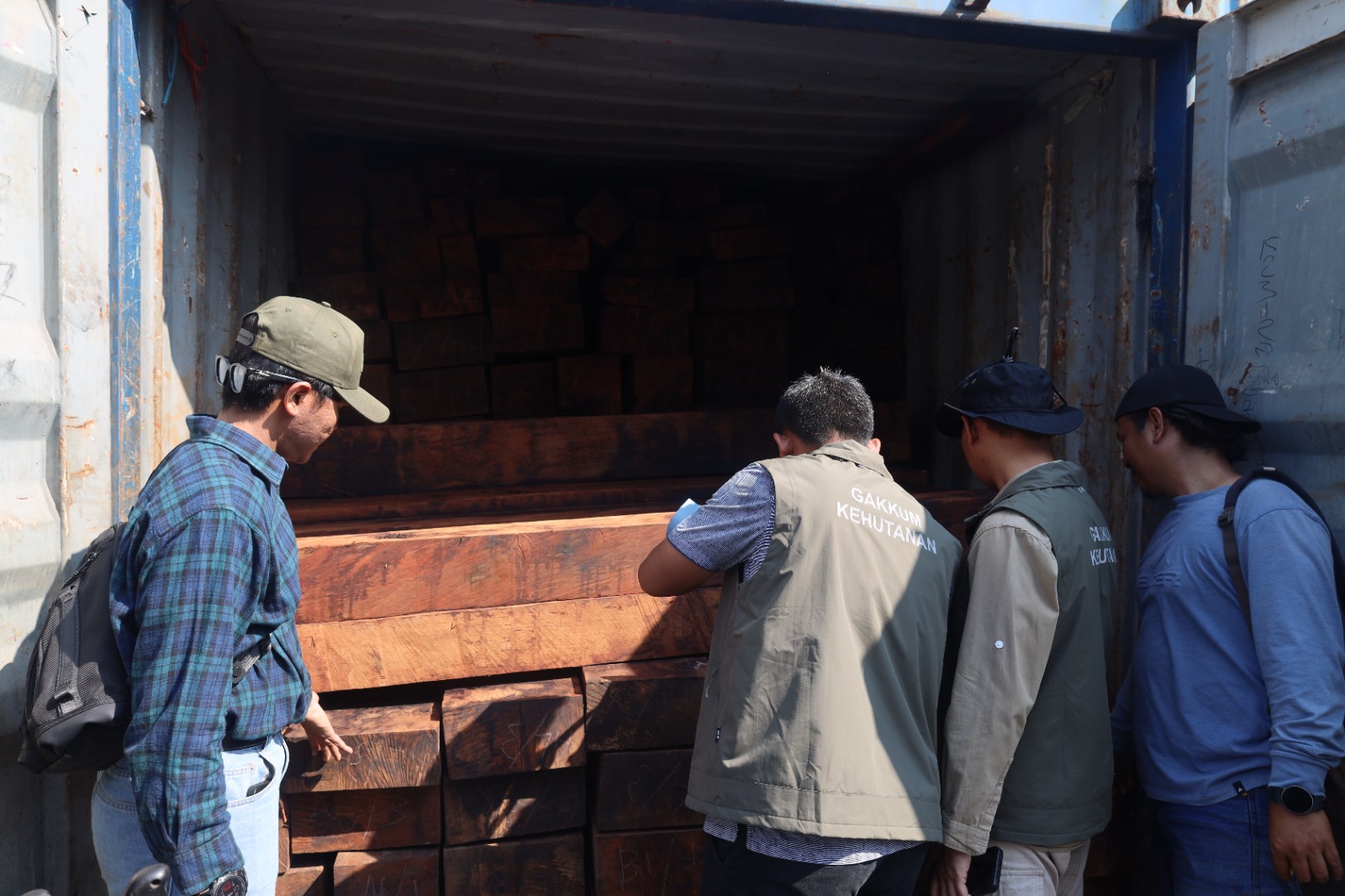
Indonesian naval authorities and East Java forestry officials have intercepted 23 containers of processed merbau timber suspected of originating from illegal logging in Central Papua’s Nabire Regency, preventing the shipment from moving deeper into commercial distribution networks. The timber, with an estimated economic value of Rp5.5 billion, was discovered during an inspection at Tanjung Perak Port in Surabaya on October 20 and 21, 2026.
The operation underscores the importance of coordinated maritime oversight in protecting Papua’s forests and ensuring that regional economic activity is built on lawful, traceable and sustainable supply chains.
A Coordinated Maritime Enforcement Operation
The investigation was conducted by the Intelligence Detachment of the Surabaya Naval Area Command together with the East Java Provincial Forestry Service’s regional unit covering Java, Bali and the Lesser Sunda Islands. According to reports published by Suara Surabaya, the operation began after intelligence officers received information about a planned shipment of timber believed to have been harvested illegally in Nabire.
The case remains under investigation, and authorities are working to establish the precise violations and determine the next legal steps.
Acting on the intelligence, officers inspected the cargo of the KM Tanto Permai at the Northern West Berlian Pier at approximately 7:30 p.m. on October 20. The vessel operates a route connecting Surabaya, Makassar, Nabire, Biak, Manokwari and Surabaya, linking Papua with major commercial and logistics centers elsewhere in Indonesia.
A review of the ship’s manifest initially identified 37 containers for further examination at Tanto 2 Depot on Tanjung Tembaga Street in Surabaya.
Evidence Raises Questions About Timber Documentation
Detailed inspection found that 23 containers held processed timber, while the remaining 14 contained empty liquefied petroleum gas cylinders, scaffolding and scrap metal. Investigators reportedly became suspicious after observing that the timber pieces varied considerably in shape and dimensions. Their cutting marks appeared consistent with the use of chainsaws rather than industrial sawmill equipment, a finding that may indicate processing outside regulated forestry facilities.
Officials also found that the volume of timber did not correspond with the accompanying processed-timber documentation. The Sustainable Forest Management Agency examined the cargo and identified the wood as merbau, a valuable hardwood widely associated with Papua’s forest resources.
As adapted from reporting by Suara Surabaya, the Navy’s public information office said the timber’s estimated economic value reached Rp5.5 billion, although the final valuation and legal classification will depend on the continuing investigation.
Protecting Papua’s Natural Capital
The interception carries significance beyond the individual shipment because illegal logging can weaken the ecological and economic foundations of forest-dependent communities. Unregulated extraction threatens biodiversity, damages watersheds and reduces the long-term value of forests that can support lawful livelihoods, community forestry and carefully managed timber enterprises.
Stronger controls along maritime routes can help ensure that revenue generated from Papua’s natural resources is not detached from environmental safeguards or local accountability.
The case also demonstrates how intelligence-led inspections can strengthen regional connectivity without treating transportation infrastructure as a channel for unchecked resource extraction. Ports, shipping operators and forestry regulators occupy a critical position in verifying cargo origins, documentation and processing methods before goods enter national markets.
More consistent digital tracking, field-level verification and cooperation with local authorities in Papua could improve traceability while supporting legitimate businesses that invest in responsible production and skilled employment.
Accountability and Sustainable Development
The joint operation reflects cooperation between the Indonesian Navy and civilian forestry institutions to prevent forest products suspected of being illegally sourced from moving through sea lanes. Authorities now face the task of carefully establishing the chain of custody, identifying the parties responsible and ensuring that any enforcement action follows due process.
Sustained coordination of this kind can contribute to a broader development model for Papua in which infrastructure, trade and regional opportunity advance alongside forest protection, transparent governance and the preservation of natural resources for future generations.

