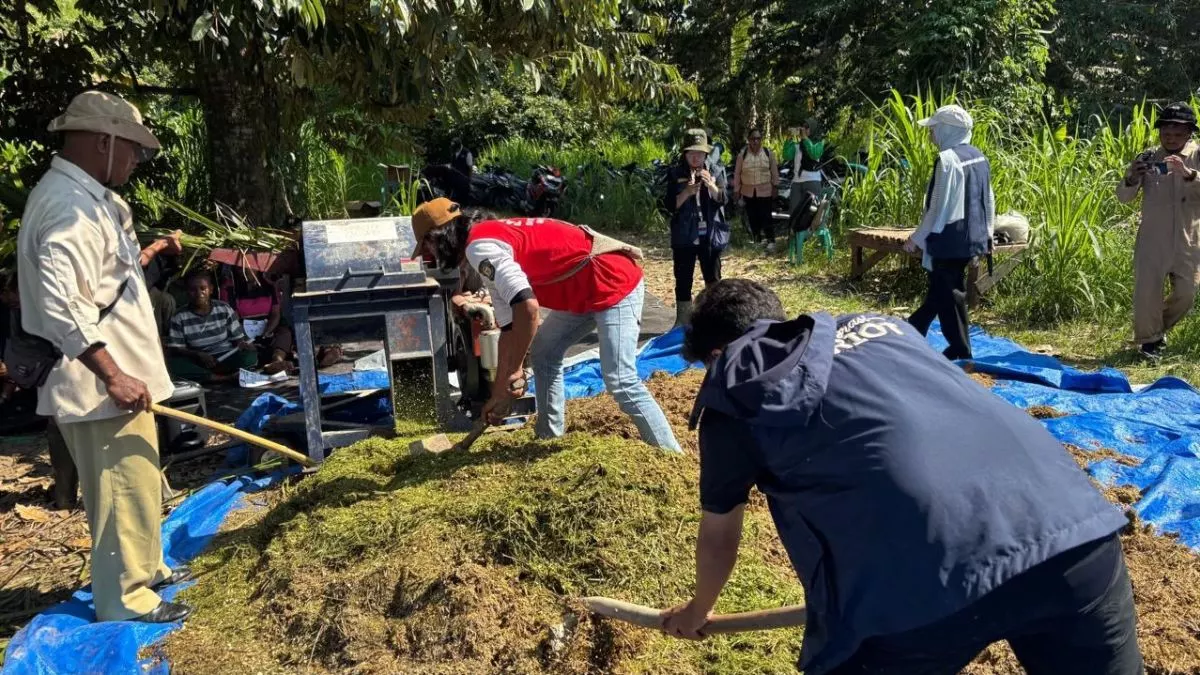
Farmers in Prafi District, Manokwari Regency, West Papua, are gaining a practical new tool to address one of livestock production’s most persistent challenges: reliable access to cattle feed. Through training delivered by the TEP team at Airlangga University, palm-oil fronds that were previously treated as plantation waste are being converted into fermented silage that can be stored and used when fresh grass is scarce.
The initiative is designed to reduce farmers’ operating costs, ease daily labor demands and strengthen the economic resilience of transmigrant communities in one of Indonesia’s easternmost development regions.
Feed availability remains a crucial factor in the sustainability of smallholder cattle operations. Farmers commonly depend on fresh grass gathered every day, leaving them vulnerable to prolonged rainfall, seasonal drought and the physical burden of searching for sufficient forage.
By turning locally available agricultural residue into a preserved feed reserve, the program links livestock development with more efficient resource use, while also demonstrating how applied knowledge can respond to immediate community needs.
A Practical Infrastructure of Food Security
As adapted from reporting by Suara.com, the training focuses on processing palm fronds through fermentation to produce silage that can be kept for later use. The process takes about 21 days, after which the material becomes a potential feed stockpile for periods when fresh grass is difficult to obtain.
The approach is especially relevant in Prafi, where palm plantations and cattle farming coexist, creating an opportunity to build a more integrated and circular local agricultural system.
The resulting silage can provide farmers with greater flexibility in managing their herds. Instead of organizing a daily search for grass regardless of weather conditions, livestock owners can draw on stored feed during extended rainy periods or the dry season.
This may help conserve labor, stabilize cattle maintenance routines and reduce dependence on purchased or increasingly difficult-to-source feed, although continued technical assistance will be important to ensure consistent quality and safe production.
Misno, a cattle farmer from the SP4 Prafi settlement, welcomed the training as an innovation with clear value for the future of his livestock business. He said farmers were pleased to be able to make use of palm fronds, but noted that the program still needed more people to support the silage-making process if it was to continue sustainably.
His observation highlights an important dimension of rural development: successful technology transfer depends not only on introducing an idea, but also on building local skills, labor networks and community-based systems to maintain it.
Connecting Research, Transmigration and Local Prosperity
The initiative reflects broader national priorities to improve food production through higher productivity, expanded production areas and downstream processing that creates greater value from agricultural resources. Those priorities were emphasized by President Prabowo Subianto during the national farmers’ and fishers’ week in Gorontalo on June 24, 2026.
In Prafi, the principle of downstream development is being applied at a grassroots level, with plantation by-products transformed into an input for livestock production rather than discarded.
The program also illustrates the role of universities and public institutions in delivering development solutions beyond academic settings. Coordinating Minister for Infrastructure and Regional Development Agus Harimurti Yudhoyono has stressed that education, research and community service should operate together to produce practical answers for national development. Transmigration Minister M.
Iftitah Sulaiman Suryanagara has similarly said that the Patriot Transmigration program must bring science and technology directly to communities, ensuring that innovation works alongside residents and generates tangible economic value.
For West Papua’s transmigrant farmers, palm-frond silage could become more than an alternative source of cattle feed. With further mentoring, organized farmer groups and reliable access to equipment and fermentation materials, it may support larger, more predictable livestock operations while encouraging better management of plantation waste.
The Prafi experience points to a broader development pathway for Papua: combining local resources, educational expertise and community participation to build resilient rural economies that are more productive, inclusive and prepared for changing conditions.

