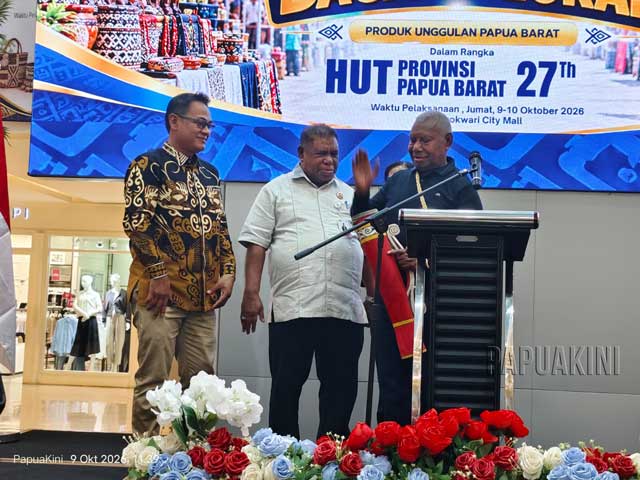
West Papua’s Industry and Trade Agency has brought 27 Indigenous Papuan small businesses together at a local trade exhibition in Manokwari, creating a focused platform to promote locally made products and strengthen their path toward national and international markets. The initiative, opened by West Papua Governor Dominggus Mandacan during celebrations marking the province’s 27th anniversary, is designed to advance downstream processing and increase the value captured by local producers.
By linking small enterprises with wider promotional opportunities, the provincial government is seeking to turn Papua’s abundant local potential into more competitive and sustainable household incomes. The exhibition also places Indigenous entrepreneurs at the center of the region’s economic development agenda.
The program responds to a practical obstacle faced by many small businesses across eastern Indonesia: products may have strong cultural identity, distinctive raw materials and loyal local customers, but limited access to promotion can prevent them from reaching larger markets. In West Papua, that gap can be especially significant for businesses operating far from major commercial centers and distribution networks.
A trade exhibition offers more than a sales venue; it can help entrepreneurs observe consumer preferences, build business relationships and present their products in a more consistent and professional manner. According to reports published by Papua Kini, the event was organized as a concrete measure to support downstream development and improve the added value of local production.
Building a Stronger Local Business Ecosystem
Industry and Trade Agency chief Bondan Santoso said the Manokwari exhibition involved 27 Indigenous Papuan business operators and was intended to help them compete beyond the provincial market. He said the principal objective was to provide promotional support so local products could gain recognition nationally and, eventually, internationally.
The agency is also using the initiative to encourage improvements in product quality and marketing practices, two areas that often determine whether a small enterprise can meet the requirements of larger retailers, institutional buyers or export-oriented supply chains. As adapted from reporting by Papua Kini, Santoso described West Papua’s local products as possessing significant potential while acknowledging that market access remains a central challenge.
The exhibition’s value therefore extends beyond the immediate opportunity to display or sell merchandise. For participating entrepreneurs, direct exposure to customers and potential partners can generate feedback on packaging, pricing, presentation and product consistency, allowing businesses to refine their offers over time.
Stronger promotion may also help producers build recognizable brands rooted in West Papua’s cultural identity and local resources, while encouraging them to formalize business operations and improve quality controls. These steps are essential for moving from informal or narrowly localized commerce toward more resilient enterprises able to serve a broader customer base.
Indigenous Enterprise and Inclusive Growth
Supporting Indigenous-owned businesses has a direct social and economic significance in Papua, where inclusive development depends on ensuring that local communities participate as producers, entrepreneurs and beneficiaries of growth. When small businesses expand, they can create additional demand for local labor, raw materials, transport services, design, packaging and other supporting activities.
The resulting business networks can help retain more economic value within the province rather than allowing local resources and products to leave the region with limited returns to communities. For Indigenous entrepreneurs, improved visibility can also transform traditional skills, agricultural output and locally inspired products into viable commercial opportunities.
The government’s emphasis on downstream processing is particularly important because it encourages products to be developed and improved before they reach consumers. Rather than relying solely on the sale of unprocessed commodities, local producers can pursue greater value through processing, branding, quality assurance and market-specific presentation.
That approach can strengthen the foundations of a more diversified provincial economy, while reducing vulnerability to fluctuations in raw-material prices and improving the prospects for long-term enterprise survival. The trade fair is one practical step in that broader transition, connecting public support with the capabilities and ambitions of community-based businesses.
Connecting West Papua to Wider Markets
The exhibition was formally opened by Governor Mandacan, accompanied by Provincial Secretary Ali Baham Temongmere, in a ceremony featuring the striking of a tifa, a traditional Papuan drum. The cultural symbolism of the opening reflected the event’s dual purpose: promoting economic participation while affirming the identity and heritage embedded in many West Papuan products.
Its longer-term success will depend on whether participating businesses receive continued assistance with promotion, standards, digital visibility, financing and distribution after the exhibition closes. Even so, the initiative signals a constructive direction for regional development—one in which Indigenous entrepreneurship, stronger local value chains and improved market access reinforce one another to support more inclusive prosperity across West Papua.
:format(webp):focal(0.5x0.5:0.5x0.5)/papuatengah/foto/bank/originals/tekan-angka-penggangurannn.jpg)